
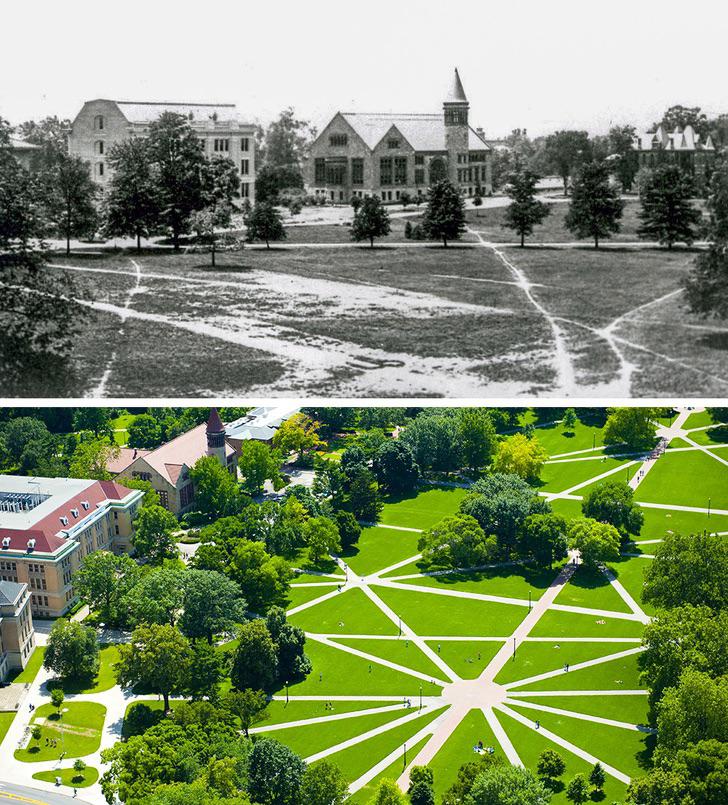
Empathy is what drives connection. This is why we have to design with the user in mind. In my research on the topic, I found two ways design helps or is designed with the user in mind. One from a college campus and one from an establishment in the US.
The first image is from the Ohio State University, where the university made a massive lawn as a green addition to its campus. Over time, staff and students created something called desire paths. These paths are formed when people walk a less time-consuming and/or easier path to their destination. Crossing the grass to get to class was easier and quicker than walking around the lawn. The campus had two choices: Close off the lawn with a fence to keep the grass pretty or use it to design paths on campus. They did the latter of the two choices and developed paved roads based off-of these desire paths to make life easier for students. This is a principle urban designers now use to create effective road systems and for UX/UI designers.
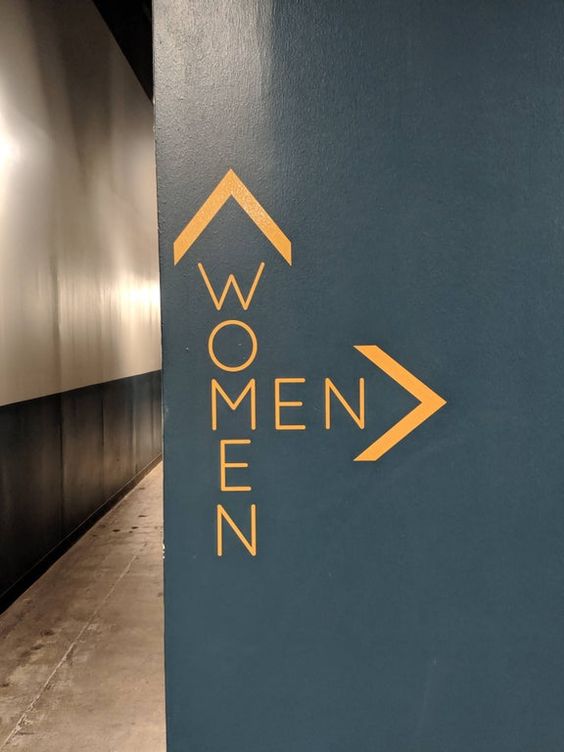
Example two is from a Reddit post user MSGuzy shared on a subreddit for great design.
This, clever bathroom sign is, in my mind, an excellent way to design with the user in mind. We are designed to conserve energy and to survive. If your mind has to work to find what it needs to survive, it better be worth it. Take this sign for example.
One sign, two messages. The user might be in a hurry, have their mind elsewhere or is simply not very perceptive. In this case, it caters to all groups. It clearly communicates, without much energy consumption, where the individual has to go.
I conclusion: If design isn’t helping the user survive or thrive, then the design becomes a hinder and people rebell. I’ve discovered this in past projects, as well when I researching desire paths. Where the roads don’t make sense or are ineffective, then both humans and animals create new paths to save time. Let’s not design products that deter the user from using the product.
Greater things are yet to come//
 Eivind got creative
Legg igjen en kommentar